
Why Is Charleston the Most Haunted City in America? The Real Answer

Charleston doesn't need a reputation. It earned one.
For more than 300 years, the same peninsula between the Ashley and Cooper rivers has been the site of pirate executions, slave revolts, two major fires, a catastrophic earthquake, repeated yellow fever epidemics, a five-day pirate blockade, the opening shots of the Civil War, and two centuries of antebellum violence whose moral weight never fully left the buildings that witnessed it. Travel writers like to call Charleston "one of America's most haunted cities." We have been telling its stories for twenty years, and we think the question deserves a more honest answer than a marketing line.
Here is the real answer. There are five reasons Charleston is haunted, and four of them are documented in the historical record.
Reason One: The City Was Built on the Atlantic Slave Trade
More enslaved Africans entered North America through Charleston than through any other port in the United States. By some estimates, forty to fifty percent of all African Americans alive today have an ancestor who was processed through the Sullivan's Island pest houses and the Gadsden's Wharf market.
The full weight of that fact does not show up in the brick and ironwork of historic downtown. It shows up at the Sugar House on Magazine Street, where enslaved people were sent for "correction" by treadmill and lash. It shows up at the Aiken-Rhett House, where the slave quarters still stand as they were built. It shows up at the Old City Jail on the same Magazine Street block, where Denmark Vesey was held in 1822 before being hanged for organizing the most ambitious planned uprising in American history.
Charleston is haunted because Charleston was a place where extreme violence was done to human beings for two and a half centuries, and the buildings where that violence occurred are still standing. The historian and Nobel laureate Toni Morrison observed in 1989 that the slave trade has "no suitable memorial, or plaque, or wreath or wall, or park or skyscraper lobby." She was speaking specifically about Sullivan's Island. A modest bench was placed there in 2008 in response. Charleston's haunting is not metaphorical.
Reason Two: Disease Killed Charleston Repeatedly
Yellow fever swept Charleston in 1699, 1706, 1745, 1817, 1854, 1858, and most devastatingly in 1858 when more than seven hundred people died in a single summer. Cholera came in 1836 and again in 1849. Smallpox returned in waves. The 1699 yellow fever outbreak killed roughly a third of the city's population in a matter of weeks.
A city with that kind of death-density develops its own relationship with the dead. Charleston's Victorian mourning culture, the layered cemeteries inside the peninsula, the cast-iron fences around private burial plots in residential gardens, and the very practice of in-town burial all reflect a population that was perpetually preparing for the next epidemic.
When you walk past Circular Congregational Church on Meeting Street and look at the burial ground there, you are looking at America's oldest continuously used Protestant cemetery. Some of the stones predate the church itself. The names on many of them have been erased by 300 years of weather. No full count of how many people are buried under the soil of downtown Charleston has ever been completed.
Reason Three: Pirates, Patriots, and the Public Execution Ground
For a brief period in 1718, Charles Town (as Charleston was then called) was the most dangerous port in colonial America. In May of that year, the pirate Edward Teach, known to history as Blackbeard, blockaded the harbor for nearly a week, stopping every ship attempting to enter or leave, seizing nine vessels, and threatening to execute the hostages he had taken from prominent Charleston families unless the colonial government supplied his fleet with medicine. Governor Robert Johnson surrendered to the demand.
Six months later, Charleston had its revenge. Colonel William Rhett captured Stede Bonnet, "the Gentleman Pirate," in a sea battle off Cape Fear. Bonnet was tried in Charleston, convicted, and hanged at White Point Garden on December 10, 1718, reportedly clutching a small bouquet of flowers at the gallows. His body was left to rot at the low-tide line as a warning. Dozens of other pirates were executed at the same spot during the colonial period.
White Point Garden is now a public park at the tip of the peninsula where families picnic and children play on a Sunday afternoon. The execution ground was never relocated. The park is built over it.
When the Revolution came, Charleston paid the price of being a strategic port. The 1780 Siege of Charleston was the worst American defeat of the war, with more than five thousand soldiers captured. The British turned the Old Exchange basement, known as the Provost Dungeon, into a military prison. Patriots died there in the damp dark of the brick chambers, and the dungeon is still accessible today. It is one of the most visited haunted locations in downtown Charleston.
Reason Four: The 1886 Earthquake That Almost Erased the City
At 9:50 PM on August 31, 1886, the ground beneath Charleston moved. The earthquake, now estimated at magnitude 6.9 to 7.3, killed at least sixty people, damaged or destroyed nearly two thousand buildings, started fires across the peninsula, and was felt as far away as Cuba, Bermuda, and New York City. It remains the most destructive earthquake in the history of the southeastern United States.
The 9:50 PM detail matters. Many people were already in bed. Children died in collapsed bedrooms. The Unitarian Church tower collapsed through the roof of the nave. The steeple of St. Philip's Church was severely damaged. Whole blocks of homes on Tradd Street and Meeting Street were rebuilt from the ground up in the eighteen months that followed.
The most visible scar is still on the buildings. After the earthquake, Charleston's masonry buildings were reinforced with long iron rods drilled horizontally through their walls and capped on the exterior with cast-iron bolts. Those bolts, often shaped as S-curves or stars, are visible on virtually every pre-1886 building in the historic district. They are the most overlooked detail in Charleston, and they are everywhere. Once you know what to look for, you cannot stop seeing them.
Locals who live in the oldest houses on the Battery sometimes describe a faint vibration in the walls at night that has no source. We are not making that claim. We are telling you what the people who live there have told us.
The 140th anniversary of the earthquake falls on August 31, 2026.
Reason Five: The Gullah Geechee Tradition Made the Lowcountry Itself Haunted
This is the reason most ghost tours leave out, and it is the most important one.
The enslaved Africans who were brought to the South Carolina and Georgia Lowcountry came predominantly from the rice-growing regions of West Africa. The geographic isolation of the sea islands and the specialized agricultural labor of indigo and rice cultivation produced a population, the Gullah Geechee, that preserved more of its African linguistic, culinary, and spiritual heritage than any other Black community in the United States.
That spiritual heritage included a fully developed framework for understanding the dead. In the Gullah tradition, a "haint" is the spirit of a person who has died but not passed on, often a person who suffered a violent or unjust death. Haints can cross the land but cannot cross water. They can be confused by sky-colored surfaces. They can be trapped in glass bottles.
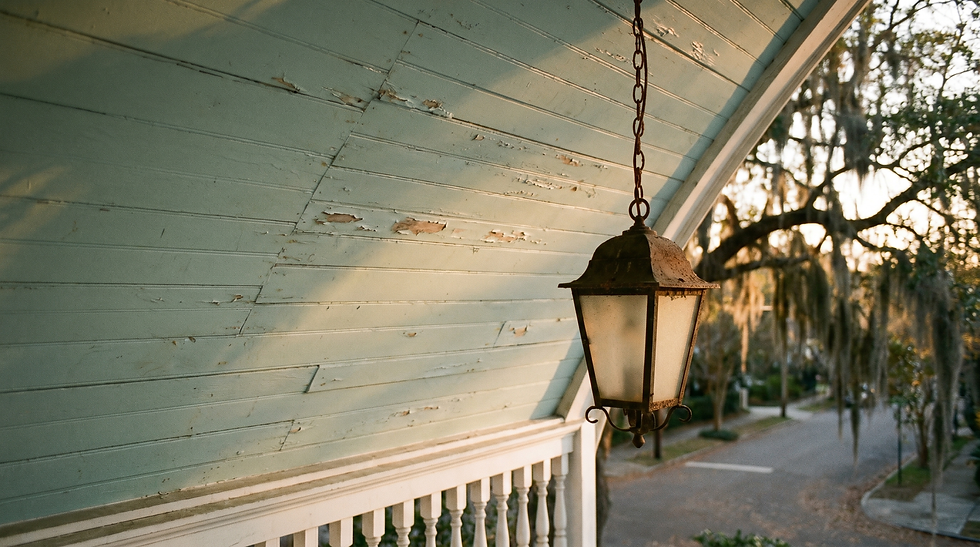
This is why almost every porch ceiling in Charleston is painted the same strange pale blue-green. The color, known as haint blue, is meant to fool restless spirits into believing they are looking at water or sky. The pigment was historically made from indigo, a crop the enslaved Gullah were forced to cultivate. The bottle trees that still appear in gardens across the Lowcountry are the same protection in different form.
The Gullah did not invent ghosts. The Gullah developed a rigorous, daily, architectural defense against them, because the conditions of their lives made the spirit world dangerous and present. That defense is now built into the literal architecture of Charleston. Every front porch in the city is a ghost trap.
If you want the longer version of this story, we cover it in Haint Blue, Boo Hags, and the Gullah Geechee Ghost Tradition of Charleston.
The One Reason We Cannot Document
We have given you four reasons backed by historical record, and a fifth backed by living cultural tradition.
The reason we cannot prove is the one most visitors come to Charleston looking for. Whether the spirits of the people who died in the Old City Jail, or on the gallows at White Point Garden, or in the collapsed bedrooms of 1886, are actually still here. We can tell you what hundreds of witnesses on our tours have reported over the past twenty years. We can tell you that paranormal investigators have documented unexplained cold zones and electronic anomalies in specific Charleston buildings under controlled conditions. We can tell you that some buildings simply feel different when you walk into them at night.
We cannot tell you what to believe.
What we can tell you is that walking these streets after sunset, with someone who knows whose blood was spilled where and whose body was buried under which sidewalk, changes how you see the city. The buildings stop being scenery. They start being witnesses.
Why This History Matters
Charleston's haunting is not a marketing gimmick. It is the cumulative weight of what was done here. The pirates hanged at the Battery, the patriots starved in the dungeon, the enslaved people sold at the wharf, the children buried after yellow fever, the people who died in their beds in 1886, the prisoners hanged for the Denmark Vesey conspiracy, the soldiers who fell at Fort Sumter and Fort Wagner. All of them lived and died in roughly twenty city blocks.
A ghost tour done well is not separate from history. It is a way of sitting with history, of making it present rather than leaving it safely in the past.
Walk Where the History Happened
Ghosts of the South has been telling Charleston's haunted history for more than twenty years. Our guides are licensed by the City of Charleston. We have been featured on the Discovery Channel and Ghost Adventures.
Tours depart nightly from 80 North Market Street at 7:00 PM, 8:00 PM, and 9:30 PM. Wheelchair accessible. Active-duty and veteran military are free with uniform or ID.
$35 per person at the door. $30 when you book online.
[BOOKING BUTTON: Book Your Charleston Ghost Tour]
Sources consulted: National Park Service "Discover Our Shared Heritage" Charleston travel itinerary; USGS Historical Earthquake Database; Wikipedia articles on the 1886 Charleston earthquake, Stede Bonnet, Blackbeard, Denmark Vesey, Sullivan's Island, Haint Blue, and Emanuel African Methodist Episcopal Church; Roger Pinckney, "Blue Roots: African-American Folk Magic of the Gullah People" (Sandlapper); Bruce Orr, "Six Miles to Charleston" (2010); Charleston Historical Society archives; Toni Morrison Society Sullivan's Island bench dedication materials; Atlas Obscura coverage of haint blue (2020); NPR "All Things Considered" haint blue feature (2006).


Comments